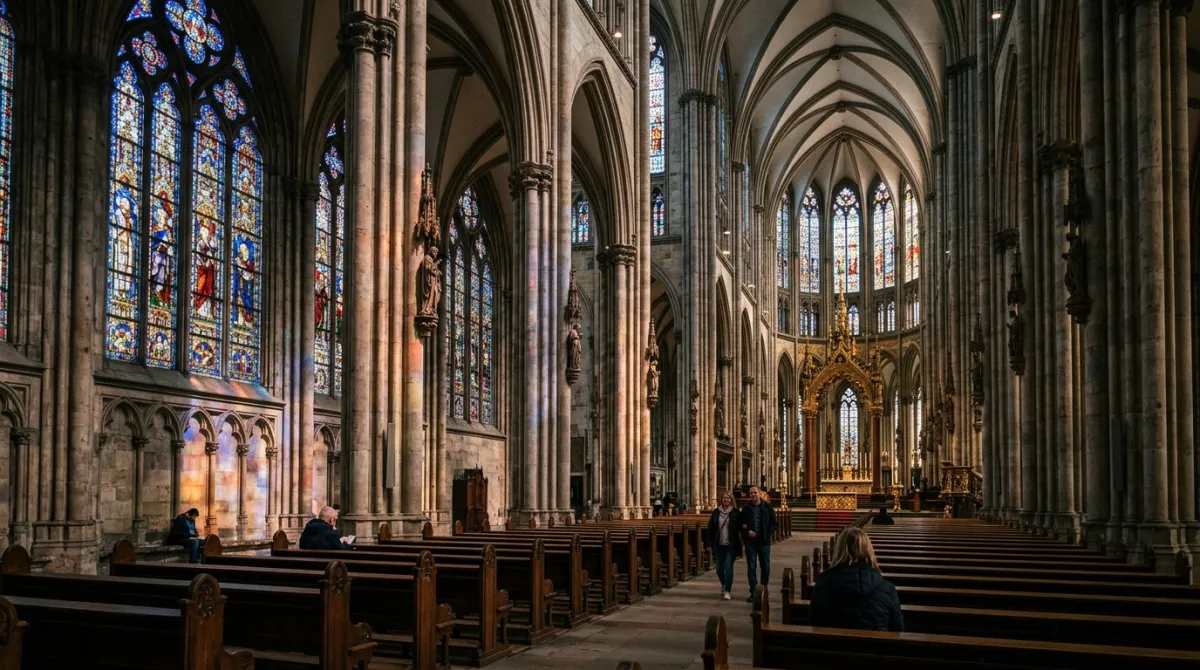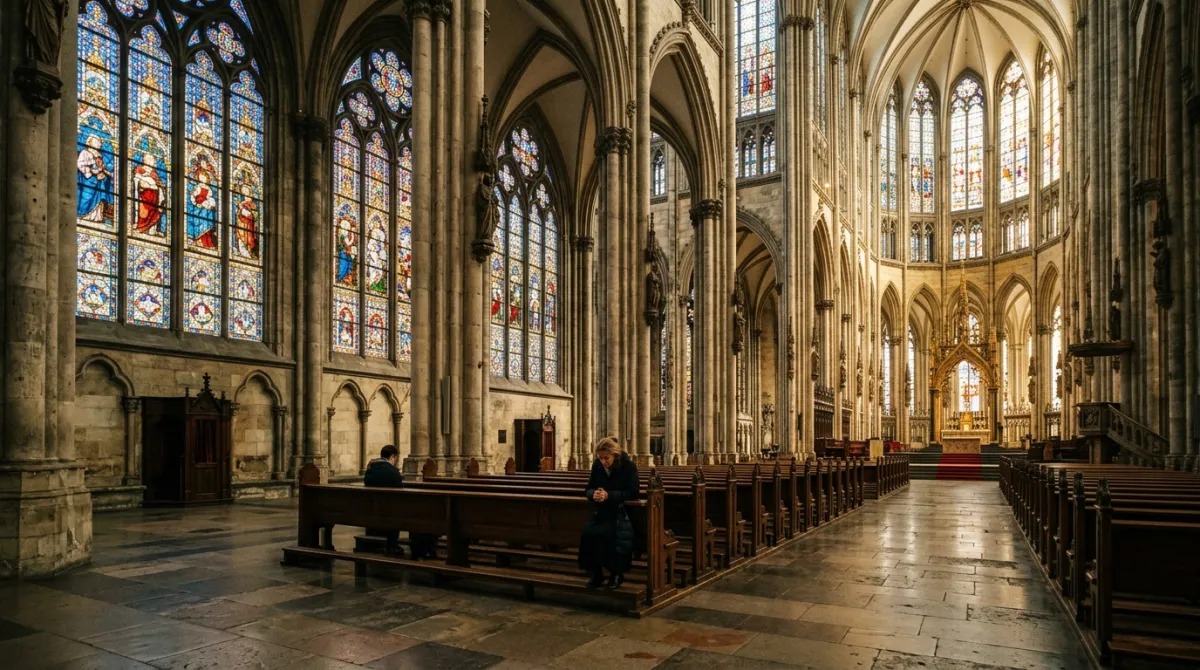
Since the early medieval period and the formation of what became the Holy Roman Empire, Christianity has been strong in the lands we now know as Germany.
This post covers common religions in Germany.
German Religion: A Historical Overview
From the formation of the Holy Roman Empire, Christianity has played a pivotal role in shaping the nation's cultural and spiritual landscape.
Challenging the authority of the Roman Catholic Church
Martin Luther initiated the Protestant Reformation in the 16th century, challenging the Roman Catholic Church.
Luther's groundbreaking translation of the New Testament into a vernacular that would eventually evolve into modern German was pivotal in unifying the language.
October 31st is celebrated in several German states as Reformation Day, a holiday.
The split between Catholic and Protestant religious communities significantly influenced the conflicts that swept through Europe during the 16th, 17th, and early 18th centuries.
Today, the Roman Catholic Church in Germany has 27 dioceses, overseen by the German Bishops' Conference. On the other hand, Protestant churches are grouped into regional churches, all of which come under the supervision of the Evangelical Church in Germany (EKD).
Religion in the Constitution
Freedom of religion in Germany is guaranteed by Article 4 of the German constitution, which states that "the freedom of religion, conscience and the freedom of confessing one's religious or philosophical beliefs are inviolable".
The Basic Law guarantees freedom of religion, encompassing both negative freedom (the right not to confess faith) and positive freedom.
There is also no state church in Germany, though there is a thing called a church tax. More on this in the next section.
Understanding Religious Affiliation in Germany
Historically, the largest religious organisations in Germany are the Protestant Evangelical Church and the Roman Catholic Church.
The churches of the dominant faith are organized into legal corporations under public law, and enjoy certain benefits such as being able to provide religious education in state schools – for example, one denomination gives a lesson for members registered under their own denomination (Catholics would go to the Catholic-organized class, and so on).
Students opting out of religious education attend an alternative class called “ethics.”
Small percentages of Germans belong to what are known as the free churches, such as Evangelical Methodists, Calvinists, Old Catholics, Jehovah's Witnesses , and the East Orthodox.
Most of East Germany's population is non-religious, a trend rooted in its communist history from 1945 to 1990.
In Western Germany, religiosity has declined, with agnostics and atheists making up about one-third of the population.
Also, fewer people who identify as part of the Christian denomination tend to attend church services.
Attitudes to Religion in Eastern Germany
Attitudes toward religion in East Germany reflect its communist history from 1945 to 1990.
During this period, the state implemented an atheist ideology, discouraging religious practices and fostering a secular society.
Churches faced restrictions, and religious communities and institutions were often marginalized. As a result, the majority of the population in East Germany tends to be non-religious, a trend rooted in the historical suppression of religious expression during the communist era.
This legacy contributes to higher rates of agnosticism and atheism compared to Western Germany.
Attitudes and Community Engagement in Western Germany
In Western Germany, attitudes toward religion and community engagement reflect historical influences and current trends.
While the region, like the rest of the country, has Christian roots, there has been a noticeable shift toward secularism in recent decades. Religiosity and church attendance have diminished, and a significant portion of the population identifies as agnostic or atheist.
Despite this trend, Western Germany hosts diverse religious communities, including Catholic and Protestant. Community engagement often takes on a pluralistic character, with citizens participating in a range of secular and religious activities.
Interfaith dialogue initiatives have gained traction, fostering understanding and tolerance among different religious groups.
As Western Germany continues to navigate the complexities of contemporary religious landscapes, community engagement becomes a key factor in shaping the region's cultural identity and fostering a sense of unity among its diverse population.
The Church Tax...
The church tax ("Kirchensteuer") stems from a historical practice of rulers maintaining churches and graveyards.
While Germany has no formal state religion, the church tax supports religious organisations, covering maintenance of buildings and clergy salaries.
Only people registered under the denominations (which are registered as legal corporations under public law) have to pay church tax, with the idea that Catholics would then help to pay for the maintenance of their own (Catholic) churches, and so on.
The Jewish faith is also considered a taxable faith, depending on the German state, due to the large population of Jewish people there (third-largest Jewish population in Europe).
© Pixabay
…and how to avoid it
To avoid church tax, individuals can officially declare they are “leaving the church.”
The number of Germans identifying as non-religious may partly stem from the church tax, as more have opted out of membership. (You can see what it would cost, and how to file, at this website (German language only).
Catholic and Protestant clergy may refuse burial for those who have formally left the faith.
Currently, the issues revolving around church tax – who can administer it, who can distribute it, who has to pay it and why – are hot issues when it comes to matters of religion and the state in Germany.
But as more people within Germany no longer identify with religious organizations, the religious organizations and churches in question are facing dilemmas about how to maintain themselves and how to change.
Islam and Juadism
Christianity is the dominant religion in Germany, while Islam is the largest non-Christian faith.
Historically, trade with the Ottoman Empire in the 18th century laid the groundwork. Today, postwar immigration, especially from Turkey, has increased the Muslim population.
Many Jews returned to Germany after reunification, viewing cities like Berlin as more welcoming than those in ex-Soviet bloc countries. The Jewish community is represented by the Central Council of Jews in Germany, which was established in 1950.
There's also a significant presence of Orthodox Christians originating from Greece, Serbia, Romania, Russia, and other countries from Eastern Europe and the Near East.
Impact of Immigration on Religion in Germany
Recent immigration has made Germany increasingly multi-religious. Historically, the influx of immigrants, particularly in the postwar period and later waves of migration, has contributed to the increased religious diversity within the country.
Immigrants from Muslim-majority countries, particularly Turkey, have made Islam the largest non-Christian religion.
This demographic shift has prompted a reevaluation of the country's religious landscape, challenging traditional notions of a predominantly Christian society.
This diversity has sparked debates about integration, coexistence, and the role of religion in public life.
Germany's approach to accommodating various religious minorities and practices and fostering interfaith dialogue remains central to addressing the complexities arising from immigration and ensuring a harmonious coexistence of different religious communities within its borders.
Religious Festivals and Traditions in Germany
Religious festivals and traditions in Germany reflect the country's cultural and historical diversity.
Germany is predominantly Christian, with Roman Catholic and Protestant communities celebrating festivals like Christmas and Easter, alongside various secular and regional celebrations.
One of the most iconic is Oktoberfest, a Bavarian tradition with roots in the Catholic celebration of Saint Martin's Day. It has evolved into a globally renowned festival, featuring German beer, food, and lively festivities.
Karneval (Carnival) is also widely celebrated, particularly in the Rhineland, where colorful parades, costumes, and merriment mark the pre-Lenten season. The influence of Protestant Reformation is evident in Reformation Day, observed on October 31st, commemorating Martin Luther's historic act.
Furthermore, German Christmas markets, known as Weihnachtsmärkte, are celebrated across the country, offering a festive atmosphere with stalls selling crafts, food, and seasonal delights.
These festivals showcase Germany's religious heritage and highlight community and cultural identity.
Religiosity and Secularization in the EU
Trends in religiosity and secularisation across the EU show a significant shift in the continent's spiritual landscape.
A decline in church attendance and a diminishing number of individuals professing religious beliefs are observable across most EU countries.
The 2010 Eurobarometer survey highlighted that, on average, 51% of EU citizens acknowledge a belief in God, while 26% believe in some form of spirit or life force, and 20% reject the existence of any spiritual entity.
Atheism and agnosticism have increased, with countries like France, the Czech Republic, Sweden, the Netherlands, Estonia, Germany, Belgium, and Slovenia reporting higher percentages of non-believers. Germany, with 27% of its population expressing non-belief, exemplifies this trend.
Conversely, Romania and Malta stand out as the most religious societies, with minimal non-believers. Factors influencing belief include age, upbringing, education levels, political leanings, and priorities in ethical considerations.
The data underscores a broader pattern of shifting attitudes toward religiosity and secularization, marking a transformative phase in the religious landscape of the EU.
Environmentalism and Spirituality
Against the backdrop of climate change and escalating environmental concerns, Germany stands as a significant example of the intersection between environmentalism and spirituality.
The global phenomenon of the "greening" of religions is observable in Germany through the emergence of eco-theologies and spiritualities that emphasize environmental consciousness.
Local religious communities actively engage in environmental protection activities, aligning their beliefs with a commitment to safeguarding the planet.
Public statements from German Christians and leaders, echoing the sentiment of global figures like Pope Francis, draw attention to ecological problems and advocate for pro-environmental policies.
The impact of Pope Francis' encyclical Laudato Si' reverberated not only within the Catholic Church but also resonated with climate scientists, media, and environmentalists.
The encyclical catalyzed discussions about climate change and its moral dimensions, exemplifying the potential influence of religious leaders in shaping public concern for environmental issues.
This confluence of spirituality and environmentalism in Germany underscores a broader trend within global faith traditions, emphasizing the shared responsibility to address environmental challenges and fostering a deeper connection between religious beliefs and ecological stewardship.
Frequently Asked Questions
In this section, I answer common questions relating to the topic of religion in Germany.
What percentage of German Christians are Catholic?
Approximately half of the Christian population in Germany is Catholic. This reflects a near-even split between the Roman Catholic Church and the Protestant Church in Germany's population.
Does Germany teach religion?
Yes, Germany does teach religion in schools. Religious education is part of the curriculum in many schools, with lessons typically offered by both the Protestant Church and the Catholic Church.
Students who do not wish to participate in religious education with a Christian church can opt for an alternative subject, like ethics. In Berlin, a few public schools also offer instruction for Buddhists and many schools in the country offer Islamic religious instruction.
Is there religious freedom in Germany?
Yes, there is freedom of religious or philosophical creed in Germany. The country's Basic Law guarantees freedom of religion, allowing individuals to practice their faith without interference. This includes the freedom to either practice or not practice a religion, ensuring a diverse and tolerant religious landscape.
What is the fastest growing religion in Germany?
As elsewhere in Western Europe, Islam is considered to be the fastest-growing religion in Germany. This growth is primarily attributed to immigration, with a significant number of people belonging to Muslim religious communities coming from countries like Turkey, Syria, Afghanistan, and Iraq.
Summing Up: What Is the Main Religion in Germany?
In conclusion, Germany's religious landscape is a complex and evolving tapestry, deeply influenced by its history and modern societal changes.
As a country where Christianity, particularly Protestantism and Catholicism, have played a central role since the Holy Roman Empire, Germany today stands as a multi-religious nation with no official state church.
The impact of Martin Luther's Reformation, the unique church tax system, and the constitutional guarantee of freedom of religious practice reflect the intertwining of religion and state over centuries.
Today, Germany remains a fascinating example of a modern, multi-religious country adapting to changing times and diverse religious groups.
If you'd like to learn more about the German language and culture, join me on SmarterGerman today.